One price · four cards · four answers
Bonus buy: a hundred stakes
The bonus buy is the only purchase in the game with a fixed, published price. What it hands back changes with the difficulty card, and that is where the decision actually lives.
Press the bonus buy and the round starts in the bonus state instead of waiting for one. The price is the same on every card: one hundred stakes.
The price, at four stake sizes
| Stake | Bonus buy costs |
|---|---|
| 0.20 USDT | 20 USDT |
| 1 USDT | 100 USDT |
| 5 USDT | 500 USDT |
| 20 USDT | 2,000 USDT |
There is no discount, no tiering and no card that buys cheaper. One hundred stakes, everywhere.
The first line of that table is the one worth staring at. A twenty-cent stake sounds like nothing; its bonus buy costs twenty USDT, which is a full minimum deposit at most operators. The purchase is not a small extra on top of your stake — it is a hundred rounds of your stake, spent at once.
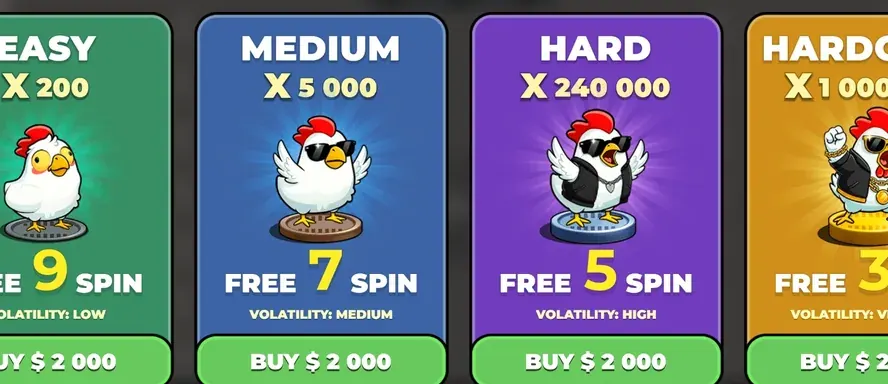
What each card hands back
| Card | Bonus rounds granted |
|---|---|
| Easy | 9 |
| Medium | 7 |
| Hard | 5 |
| Hardcore | 3 |
Same price, different count. Easy hands over nine rounds for a hundred stakes; Hardcore hands over three. That is not a worse deal on its face — Hardcore's rounds reach a far larger ceiling — but it is the whole trade, stated in two columns.

What nobody can tell you honestly
The expected value of the purchase. Working it out needs the bonus round's own return, which the studio does not publish separately from the title's 98%, and nobody on this site has logged the thousands of purchases it would take to estimate it from observation.
So here is the complete honest statement, and it is shorter than any article that claims otherwise:
- The price is one hundred stakes, on every card, everywhere.
- The grant is nine, seven, five or three rounds, by card.
- Whether those rounds are worth a hundred stakes is unknown to us, and any figure you read for it elsewhere was either measured over a sample its author should describe, or invented.
If a page tells you the bonus buy “returns 105%” without saying how many purchases that came from and on which card, it is the second one.
A hundred stakes is a large share of a small balance, which is why the crypto chicken road guide starts with how to size a deposit before it starts with the board.
Three practical notes
It empties a balance quickly. One press moves a hundred stakes. A balance that would have carried an evening of ordinary rounds carries four purchases.
It does not change the settle-at-commit rule. The bonus rounds are still drawn at commit; the purchase buys the state, not an outcome. See how the lanes work.
A bonus balance may not be allowed to buy it. Operators frequently exclude feature purchases from bonus funds, and where they do not, the purchase usually counts oddly towards wagering. That is an operator rule, not a game rule — read it in the terms before pressing, and see the crypto cashier page for where those conditions live.
If you are trying it anyway
Use the demo first, twice, to see what the state looks like. Then, if you buy in the paid game, buy at a stake you would have played a hundred rounds of anyway — that is the honest exchange rate of the purchase, and it keeps the decision the same size as the money. The ceilings that make the purchase tempting on Hard and Hardcore are laid out on the Chicken Road 2 page.