Rules · one button · one decision
How the lanes work
Everything in this game happens between two presses: the one that commits a stake and the one that takes the multiplier under the chicken's feet. This page is what sits between them.
There are four controls on the screen and one of them matters. Stake, difficulty card, forward, cash out. The first two are set before the round starts, the third does nothing except advance, and the fourth is the entire game.
Starting a round
Pick a stake. Pick a difficulty card. Press play. At that instant three things happen at once, and the order is worth knowing because it explains everything else on this page.
- The stake leaves your balance. The round is now live and the money is committed.
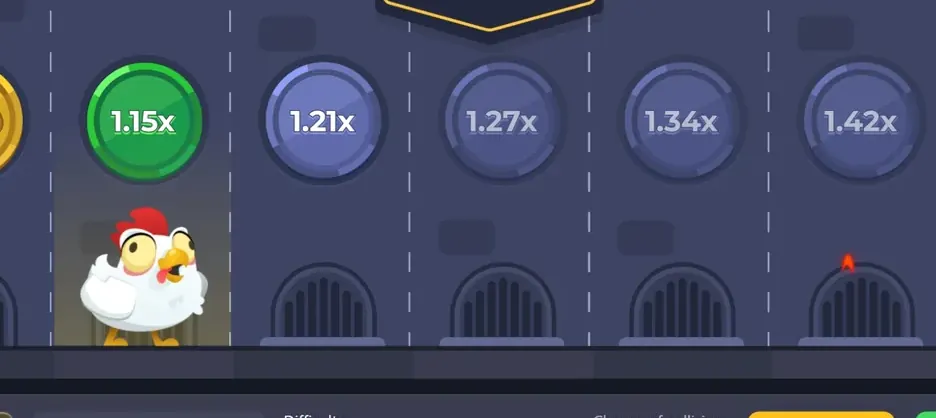
- The ladder is printed. Every lane on the road gets its multiplier, visible before you touch anything.
- The car is placed. One lane holds the car, and which lane that is was decided at commit — not while you walk, not when you hesitate.
From here the chicken is at the kerb and the road is fully described. You press forward to advance a lane, or cash out to take the multiplier you are standing on. Advance into the car's lane and the round ends with nothing.
Reading the ladder before you press
The printed ladder is the only information you need and the only information you get. Two cards, six presses each:
| Press | Easy | Medium |
|---|---|---|
| 1 | 1.01 | 1.06 |
| 2 | 1.02 | 1.20 |
| 3 | 1.05 | 1.36 |
| 4 | 1.09 | 1.54 |
| 5 | 1.13 | 1.76 |
| 6 | 1.18 | 2.03 |
On Easy the first press returns one per cent. That is not a criticism of the card — Easy prints thirty lanes and the interesting part of its ladder is at 3.70, 4.22 and 4.93, near the far kerb. It is a description of what you are buying: many small, safe-feeling steps, and a long walk before the number means anything.
Medium doubles by press six. Fewer lanes, a shorter road, a car occupying a larger fraction of it.
Choosing a difficulty card
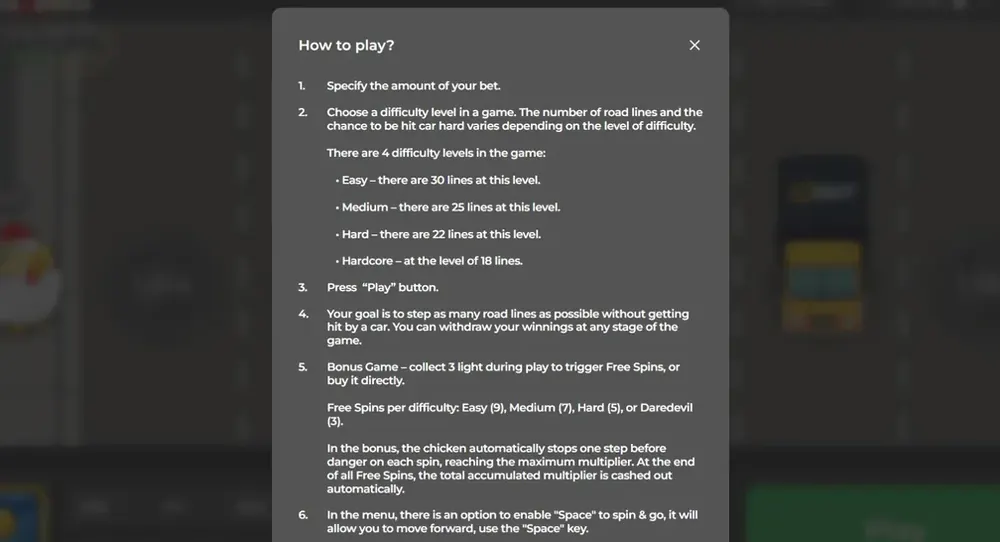
| Card | Lanes | Shape |
|---|---|---|
| Easy | 30 | Long road, shallow ladder, many exits |
| Medium | 25 | The default; doubles around press six |
| Hard | 22 | Short road, steep ladder |
| Hardcore | 18 | Shortest road, the six-zero ceiling in the sequel |
The house edge does not change between cards. What changes is variance: how often a round ends somewhere useful, and how large “useful” is when it does. A player who takes 1.5× and stops has a different experience on each card, but not a different expected result.
The only decision that is yours
Cash out. That is it. Everything else — stake size, card, the number of lanes — is chosen before the round is settled, and the round is settled at commit.
This has a practical shape. Before pressing play, decide which rung you are taking. Write it down if that helps. Then take it. The failure mode is not choosing badly; it is not choosing at all, advancing on feel, and discovering afterwards that “one more lane” had no stopping rule behind it.
Three habits that follow from how the game is built:
- Set the exit before the entry. The ladder is printed before you press. Choose your rung from it, not from how the walk feels.
- Treat every round as independent. It is. A run of safe lanes changes nothing about the next round, because the next round has not been drawn yet.
- Size the stake to the number of rounds you intend to play, not to the ceiling you hope to reach. The ceiling is on the card; the rounds are what you actually buy.
These rules are the whole of the board. What sits behind it — the coins, the networks and the cashier — is covered in the crypto chicken road guide on the home page.
What does not work, and why
Predictors. A tool cannot predict a number that was drawn before the tool was opened. Anything showing a confident overlay of “safe lanes” is showing an animation.
Press timing. Fast, slow, rhythmic, hesitant — the car's lane was fixed at commit.
Martingale and its cousins. Doubling after a loss changes the distribution of your session, not the edge. It converts many small wins into one large loss, and the table limit decides when.
The demo as a rehearsal. Demo credits cannot be lost, so the demo tests every part of the game except the one that changes behaviour. The demo page is blunt about this.
Where this goes next
If the shape of the decision appeals more than this particular road, the crash-game family is the wider shelf. The bonus buy is the one purchase in the game with a fixed price — one hundred stakes — and it deserves its own arithmetic. Chicken Road 2 keeps these rules and moves the ceilings. And the money that funds all of it goes through the crypto cashier, which is where the delays actually live.